
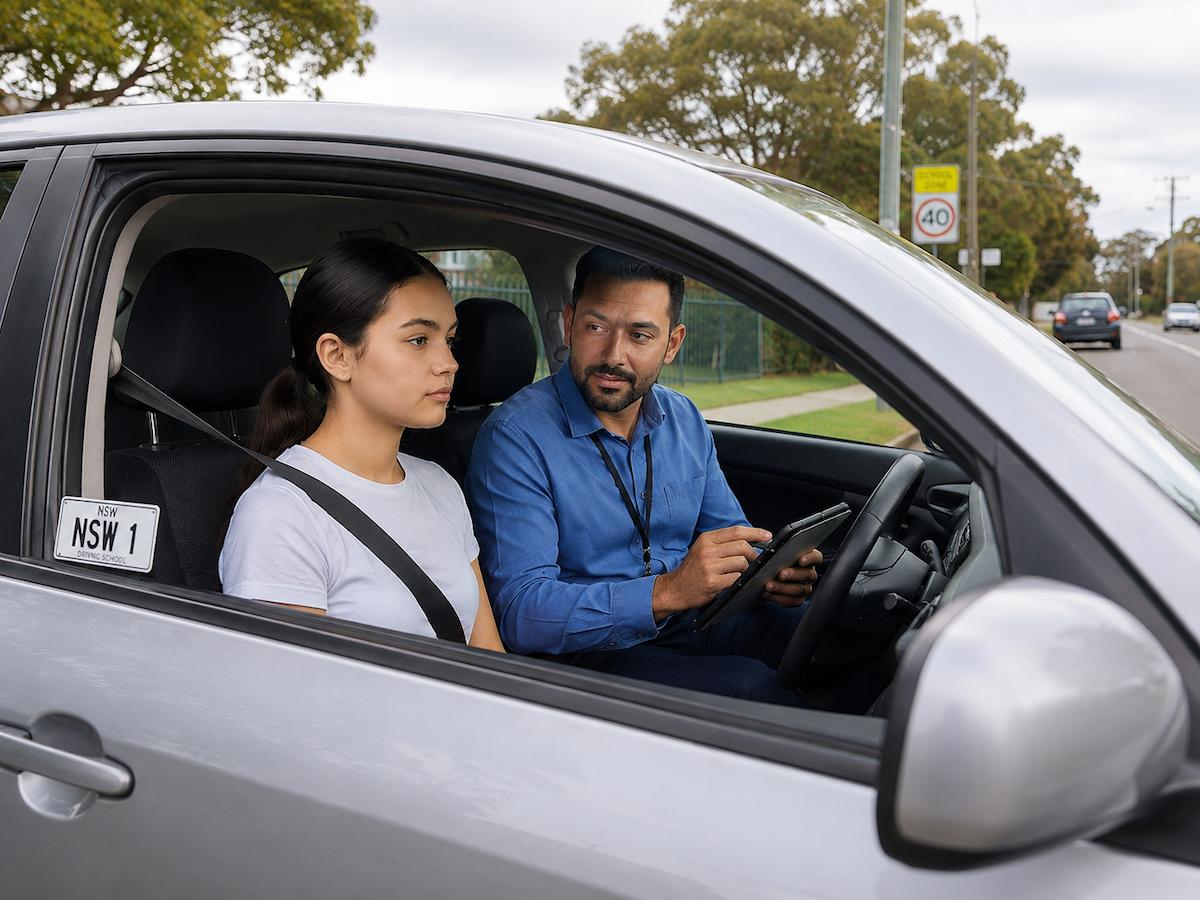
Why learners fail NSW driving test attempts is rarely about not knowing how to drive. Most learners who fail already have the skills; they just lose points on small, repeatable errors that examiners are specifically trained to watch for. Understanding these mistakes before you sit your test is one of the simplest ways to boost your chances of passing first time.
We’ve worked with thousands of learners across Sydney, and the same handful of errors explain why learners fail NSW driving test attempts again and again. If you’re already working through your driving test preparation, pairing it with this list will help you understand exactly where those lost points usually come from.
The Top Reasons Why Learners Fail NSW Driving Test Attempts
1. Forgetting Visible Head Checks
This is, by far, the most common reason why learners fail NSW driving test attempts. Checking your mirrors is not enough. Examiners are trained to look for a clear, visible head turn every time you change lanes, merge, pull away from the kerb, or reverse.
Why it happens: Under pressure, learners often check mirrors out of habit but skip the physical head turn, especially on straight roads where it feels unnecessary.
How to avoid it: Make the head check a physical reflex during every lesson, not just something you do when you remember. Saying “checking” out loud during practice helps build the habit.
2. Rolling Through Stop Signs
A complete stop means the car is completely still, with no wheel movement, for at least one to two seconds. Slowing down significantly is not the same as stopping, and this is one of the few errors that can result in an instant fail rather than a minor deduction.
How to avoid it: Practise coming to a full, deliberate stop every single time, even on quiet residential streets with no traffic in sight.
3. Poor Roundabout Positioning
Choosing the wrong lane, forgetting to indicate on exit, or hesitating too long at a roundabout entry is another reason why learners fail NSW driving test attempts, particularly at multi-lane roundabouts.
How to avoid it: Practise roundabouts specifically, not just as part of general driving. Confirm lane rules for left turns, straight-through, and right turns until they’re automatic.
4. Incorrect Speed for the Conditions
Driving exactly at the speed limit isn’t always correct. Examiners assess whether your speed is appropriate for the actual conditions, including school zones, wet roads, pedestrians nearby, or reduced visibility. Driving too slowly without reason can lose points just as easily as speeding.
How to avoid it: Practise adjusting speed naturally in response to your surroundings, not just the speed limit sign.
5. Weak Observation When Moving Off
Pulling away from a parked position without a proper blind spot check, or moving off in a way that forces another vehicle to slow down, are common reasons learners lose points early in the test, sometimes before they’ve even reached the main road.
How to avoid it: Build a consistent routine: mirror, blind spot check, indicator, and only then move off.
6. Hesitating at Give Way and Traffic Light Intersections
Excessive hesitation is treated differently to caution. Waiting too long at a clear intersection, or creeping forward and stopping repeatedly, signals indecision to the examiner and can cost points even when no actual mistake is made.
How to avoid it: Practise reading intersections confidently during lessons so decision-making feels automatic rather than something you have to think through in the moment.
7. Poor Vehicle Control During Parking
Reverse parking and parallel parking are entirely within your control, which is exactly why examiners weigh them heavily. Hitting a kerb, taking multiple attempts, or finishing at an unsafe angle are avoidable errors that cost more learners than they should.
How to avoid it: Repeat parking manoeuvres until they’re boring. This is the one part of the test where practice alone can guarantee full marks.
How These Mistakes Add Up
Service NSW allows a limited number of minor errors before a test results in a fail, and certain errors (like failing to stop completely or dangerous driving) result in an automatic fail regardless of how well the rest of the test goes. You can review the official criteria on the Service NSW driving test page.
| Mistake Type | Typical Impact |
|---|---|
| Missed head check | Minor fault; repeated occurrences add up |
| Rolling stop | Can be an instant fail |
| Poor roundabout lane choice | Minor to moderate fault |
| Hesitation at intersections | Minor fault |
| Parking errors | Minor to moderate fault |
The Fastest Way to Fix These Habits
Reading about why learners fail NSW driving test attempts is useful, but habits are only broken through repetition. A mock test with a licensed instructor, scored exactly as an examiner would score it, is the most effective way to catch these errors before test day rather than during it.
Ready to Fix These Mistakes Before Test Day?
Our licensed instructors across Parramatta, Rosehill, and Western and Eastern Sydney run dedicated mock tests that target these exact errors, backed by a 99% first-attempt pass rate. Book a test-ready lesson today and walk in knowing exactly what the examiner is looking for.
Frequently Asked Questions
Why do learners fail NSW driving test attempts most often?
Missed or incomplete head checks when changing lanes or merging are the single biggest reason why learners fail NSW driving test attempts, though rolling through stop signs can cause an instant fail on its own.
How many mistakes can I make and still pass my NSW driving test?
This depends on the severity of each error. Minor faults are tolerated up to a limit, but certain serious or dangerous errors result in an automatic fail regardless of how the rest of the test goes.
Can I fail for being too cautious or hesitant?
Yes, Excessive hesitation at intersections or roundabouts can be marked down even if you break no other rules, since it signals uncertain decision-making to the examiner.
Is a mock test worth doing before the real driving test?
Yes, A scored mock test with a licensed instructor is one of the most reliable ways to identify which of these mistakes you’re still making before they cost you on the actual test.